
Article · September 8, 2026
Your Attention Is a Puppy. And Someone Else Is Holding the Leash.
There's a moment almost everyone knows, we just somehow never say it out loud: you look up from your phone, and you have no idea where twenty minutes went. You don't remember what you saw. You remember starting, and then… And that "and then" is exactly the point: there is no "and then." There was just a scroll that didn't want to stop, and you didn't really try to stop it either, and in the end you couldn't name a single concrete thing that made it worth it.
Before I dug deeper into the topic, I thought of it as a personal weakness, a generational flaw. Now, though, we know for a fact that it's the consequence of deliberate design — and what we do about it is up to us.
This isn't your generation's problem — it's a 1971 economic prophecy
If anyone thinks the "attention economy" is TikTok's invention, I have a surprise for them. The term was introduced by Herbert Simon, Nobel laureate economist, in 1971 — long before anyone had a smartphone. His sentence still describes exactly what we're living in:
"a wealth of information creates a poverty of attention"
He explained it with a rabbit-and-lettuce image: if a world is full of rabbits, lettuce becomes the scarce resource. Information "consumes" what stays finite next to it in exactly the same way: your attention.
How much more bombarded are we than our parents were?
It's genuinely hard for someone becoming an expert in critical thinking, because the internet is full of viral stories that would back up exactly what I want to convey (e.g. "you learn more in a day than a medieval person did in their entire life"), but unfortunately none of these trace back to a reliable source — painful as it is, I'll leave them out, because the whole point here is that we shouldn't believe everything just because it's shocking at first glance.
What we do actually know: according to UC San Diego's "How Much Information?" research, the average American already consumed roughly 12 hours of information a day back in 2008 — about 100,500 words and 34 gigabytes, per day. And that number grew 5.4% a year, by byte volume, between 1980 and 2008. Important: this is a 2008 snapshot, meaning the state before the current, social-media-driven era. In other words, a floor estimate compared to what we live in now.
Your brain's own alarm system
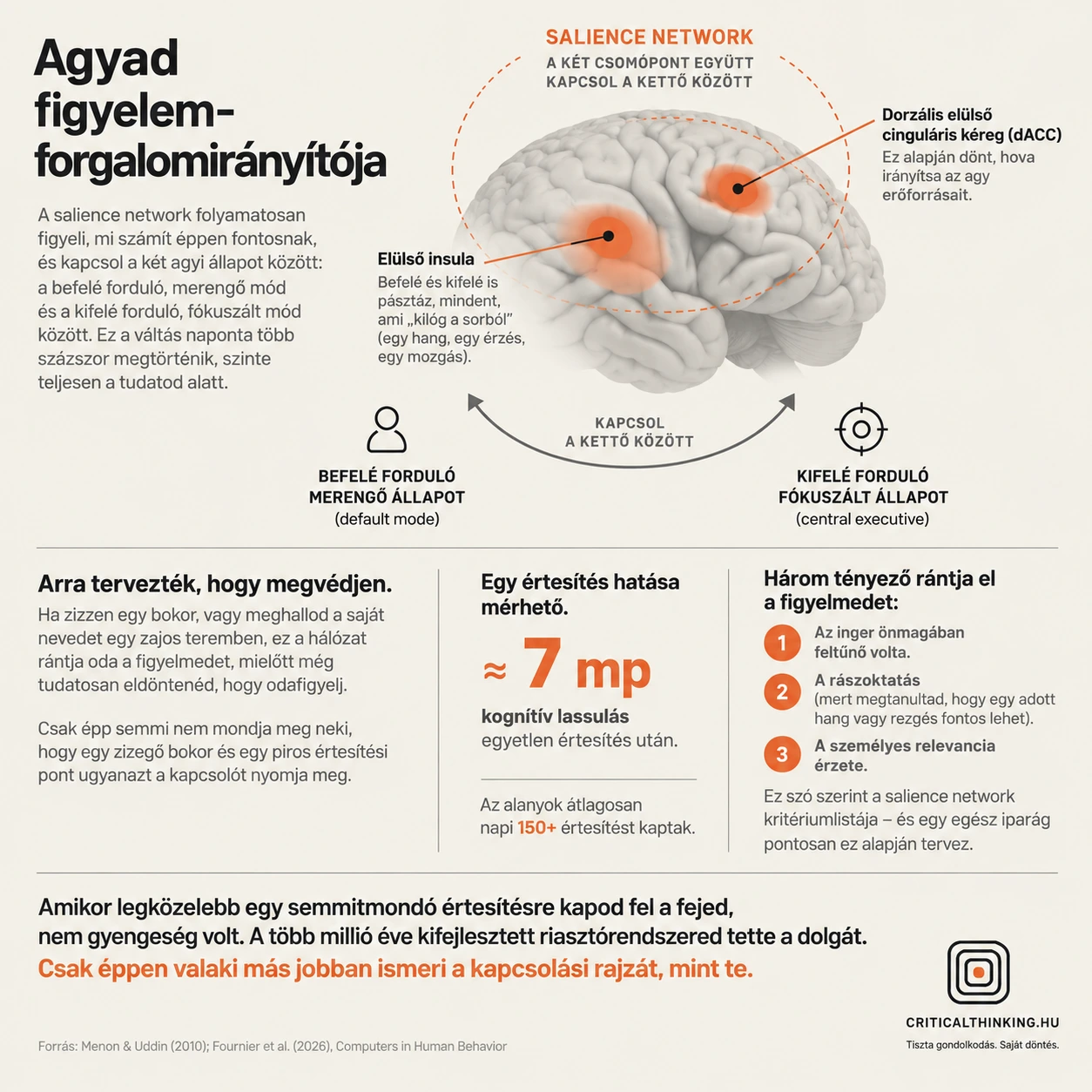
And here's the part I'm inserting after the fact, because ever since I learned about it, I can't scroll without thinking of it. There's a network in our brain whose literal job is to continuously monitor what counts as important right now — it's called the salience network. It has two main nodes: the anterior insula, which constantly scans both inward and outward for anything that "stands out from the pattern" (a sound, a feeling, a movement), and the dorsal anterior cingulate cortex, which decides, based on that, where to direct the brain's resources.
According to Menon and Uddin's 2010 model, cited thousands of times since, this network is the "traffic controller" between the two states your brain can be in: the inward-facing, mind-wandering, daydreaming state (when you're with your own thoughts), and the outward-facing, focused, goal-directed state. This switch happens hundreds of times a day, almost entirely below your awareness.
This system evolved to protect you.
If a bush rustles, or you hear your own name in a noisy room, this network is what yanks your attention there before you even consciously decide to pay attention. The only problem is, nothing tells it that a rustling bush and a red notification dot are pressing exactly the same switch.
And there's a very recent, very concrete study (Fournier and colleagues, University of Lyon, 180 university students, a lab experiment using real social-media notifications) that measures precisely this: a single notification causes about 7 seconds of cognitive slowdown every single time, and this effect doesn't depend on screen time — it depends on the number of notifications. Subjects received over 150 notifications a day on average. The researchers identified exactly three factors that hijack your attention: how inherently salient the stimulus is, conditioning (because you've learned that a given sound or vibration might be important), and the sense of personal relevance.
That's literally the salience network's own criteria checklist — and an entire industry designs precisely around it.
So the next time you snap to attention over a meaningless notification, and then get annoyed at yourself for "why did I even react to that" — that wasn't weakness. Your alarm system, developed over millions of years for exactly this purpose, did its job. It's just that someone else knows its wiring diagram better than you do, and knows exactly what signal to send to switch it on.
Dopamine doesn't give you a "boost." It reshapes you.
And here's the part that can add another layer of goosebumps to all this. Dopamine, the "reward hormone." The thing that makes us feel good, and whose absence sends our brain, on autopilot, chasing whatever it takes to get the next hit.
A 2021 study (Westbrook and colleagues, iScience) used brain imaging (PET) to look at the dopamine-producing capacity of 22 healthy adults and compared it to their daily phone-usage patterns. The result: the higher someone's proportional use of social apps, the lower their dopamine synthesis capacity was in one specific brain region (the putamen).
This doesn't mean what common wisdom suggests — that the phone "gives you a dopamine hit," like candy. It means it can durably, measurably reshape the baseline capacity of the reward system itself. The sample was small (22 people), and it's correlational, not causal research — that's worth saying plainly. But the picture it paints is exactly what I feel in my own skin: this isn't about us being weak. It's that our nervous systems really are calibrated differently now than they were ten years ago. As for how the influence of GenAI systems builds on top of all this — I haven't found research yet, only personal experience — we'll go deeper into that later.
Why is this the first firewall, of all of them?
The Attentional, or Perceptual firewall isn't first by accident. Everything that comes after it — whether you interpret something correctly, whether you make a good decision — stands or falls on whether you notice at all that something is trying to steer your attention.
In social engineering, which I worked in for years, this was the very first, most important line of defense: that small, uncomfortable, gut-level signal telling you something here isn't right. Apps, feeds, infinite scroll target this exact same mechanism, just not through a hacker — through an entire industry, professionally, A/B tested, designed with full knowledge of the neuroscience described above.
Fundamentally, not out of malicious intent. Simply because it works.
The puppy picture
Here's an image, because this is the one that stuck with me the most: your attention is like a puppy. Curious, eager, it jumps into every new scent, every movement instantly, and if you let it, it'll run from one stimulus to the next in an endless park until it collapses. This isn't misbehavior. It's its nature — specifically, its anterior insula working overtime.
The question was never how to punish it for this. It's who's holding the leash.
Because if you fall into that big average most of us do — myself included: most of the time, it's not you. It's, time and again, in the hands of a product team, somewhere in an office, whose literal job is to pull your attention back to where they make money from it, for as long and as often as possible.

What I'd ask you to take with you
If there's one thing I want to stick from this:
your attention, and where you focus your mental capacity, is one of the most valuable assets you own.
Not your degree. Not your network. What you look at, and how long you can hold your attention there before someone else takes it elsewhere.
This isn't something you can "solve" once and for all. You can't quit being a puppy, and you don't need to. But you can learn to lead. That's the essence of the Attentional firewall: not never wandering off, but noticing when someone else is pulling the leash, and consciously taking it back into your own hands.
Next time, we'll take apart the Interpretation firewall — why we believe something without checking it.
Sources
- Herbert A. Simon: Designing Organizations for an Information-Rich World (1971)
- Roger E. Bohn, James E. Short: How Much Information? 2009 Report on American Consumers, UC San Diego, Global Information Industry Center
- Gloria Mark's research on attention switching (UC Irvine, 2004 and 2016 studies; summarized in her book Attention Span)
- Vinod Menon, Lucina Q. Uddin: Saliency, switching, attention and control: a network model of insula function, Brain Structure and Function, 2010.
- Fournier et al.: Attention hijacked: How social media notifications disrupt cognitive processing, 2026.
- Alex Westbrook et al.: Striatal dopamine synthesis capacity reflects smartphone social activity, iScience, 2021.
- The origin and debunking of the "8-second goldfish myth" — BBC (2017); Jason Miller's investigation (2016)